Case Study: Load Balancing in 5G Using Cell Individual Offset (CIO)
Summary
This case study describes our work with a mobile network operator to use Cell Individual Offset (also termed Cell Specific Offset) for balancing User Equipment (UE) association in a 5G network. The aim was to balance the load across base stations without changes to hardware or to the physical deployment.
We used NetSim simulations to assess the effect of CIO adjustments on UE distribution and resource utilization. The operator evaluated gNB configuration changes for load balancing in controlled simulations before deployment.
Problem Statement
The network scenario had three collocated gNBs (low-band, mid-band and high-band) at 1.5 GHz, 2.6 GHz and 3.5 GHz. For simplicity, we modeled only one sector in a 500 m × 500 m area, with all gNBs at the top-left corner.
The sector had 500 UEs: 15% in the near-cell region, 25% in mid-cell, and 60% at the cell edge.
Propagation loss differs across frequency bands, so the UE association was skewed. The lower-frequency gNB attracted a higher number of UEs because of its larger coverage, leading to resource overload and congestion. In contrast, the higher-frequency gNB was underutilized.
The operator needed a way to influence UE association without changes to the physical deployment or network architecture.
Approach
Cell Individual Offset (CIO) modifies User Equipment (UE) cell selection by artificially adjusting the Reference Signal Received Power (RSRP) measurements used in handover and reselection decisions.
A positive CIO (for example, +4.77 dB) makes a cell appear stronger than it is, and steers UEs towards it. A negative CIO (for example, -4.77 dB) makes a cell appear weaker, and steers UEs away from it. In this case study, applying a negative CIO to the congested low-band gNB and a positive CIO to the underutilized high-band gNB shifted UE attachments.
All other parameters, including scheduler behaviours, remained unchanged.
We measured UE distribution, PRB usage, and throughput impacts across simulations.
With NetSim, the operator tested "what-if" CIO values quickly and identified the best offsets before deployment.
Simulation Setup
Network Topology
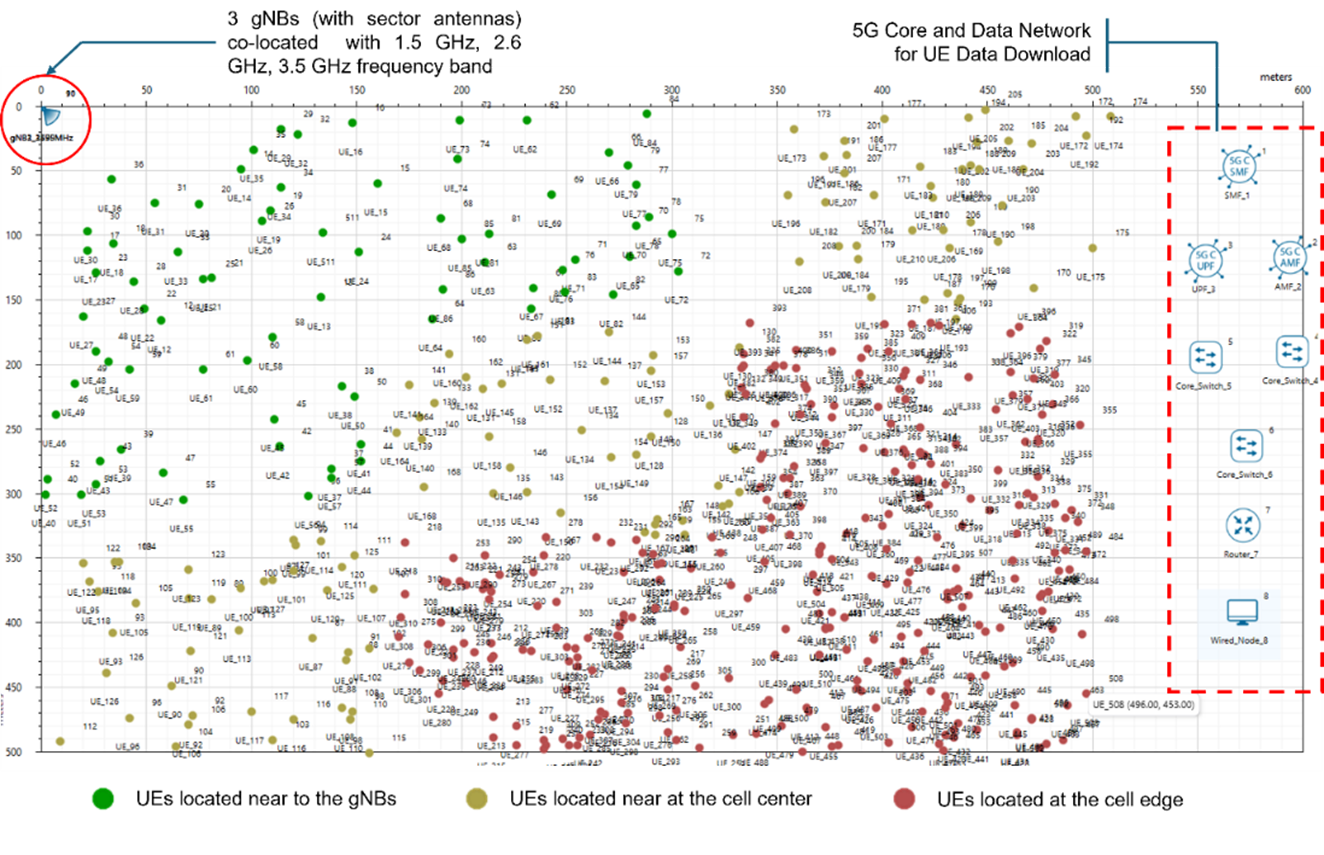
Fig: A single sector with 3 collocated sector gNBs in the top left - operating in low, mid and high bands. There are 500 UEs with 15% near cell (green), 25% mid cell (yellow) and 60% cell edge (red).
Simulation parameters
| Parameter | Value |
|---|---|
| Simulation Area | 600 m x 500 m |
| Number of gNBs | 3 (sectorized) |
| Number of UEs | 500 (15% near, 25% mid, 60% edge) |
| Channel Bandwidth | 40 MHz (each gNB) |
| Path Loss Model | Log distance (pathloss exponent = 3.8) |
| Shadowing | Log-normal |
| Simulation Time | 100 seconds |
| Traffic | Downlink, full buffer |
| Antenna | 4T4R |
| Transmit power | 80W/port |
| CIO settings |
gNB 1 (1.5 GHz): - 4.77 dB gNB 2 (2.6 GHz): 0 dB gNB 3 (3.5 GHz): + 4.77 dB |
Asymmetric offsets (-4.77 dB low-band, +4.77 dB high-band) compensated for path loss disparity at 3.5 GHz vs. 1.5 GHz
Results
UE Association Distribution
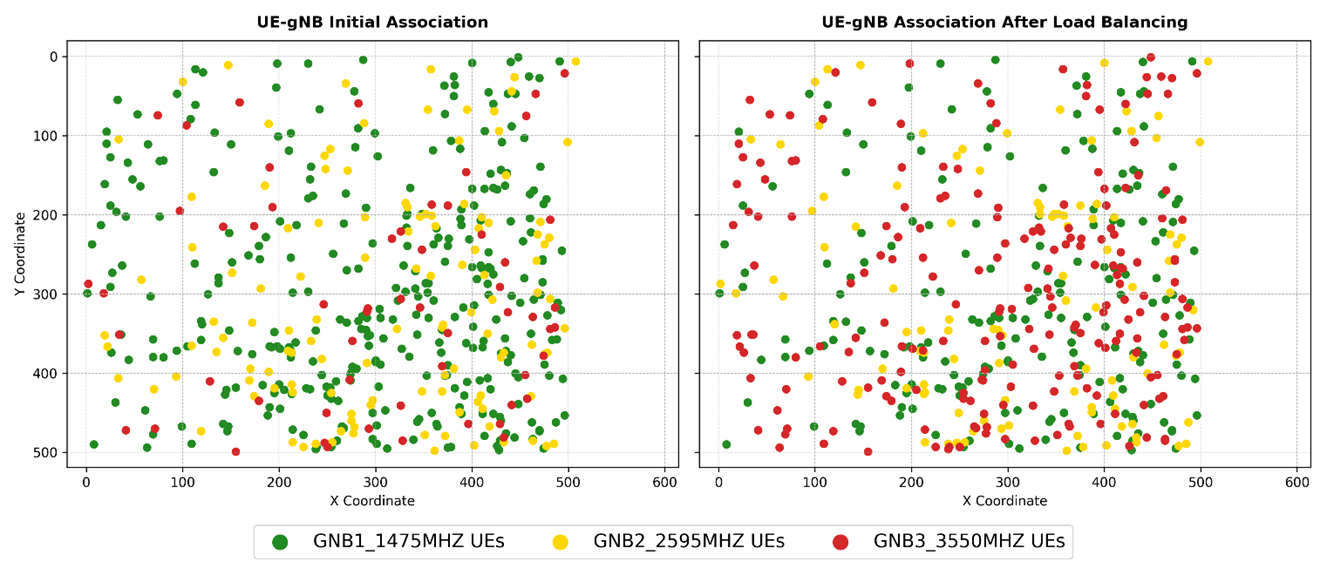
| gNB ID | Band | UEs (Before load balancing) |
% | UEs (After load balancing) |
% | Change |
|---|---|---|---|---|---|---|
| gNB1 | Low | 321 | 64.2 | 251 | 50.2 | ▼ 14.0 |
| gNB2 | Mid | 122 | 24.4 | 116 | 23.2 | ▼ 1.2 |
| gNB3 | High | 57 | 11.4 | 133 | 26.6 | ▲ 15.2 |
After CIO adjustment, the number of UEs associated with gNB1 decreased, while the number associated with gNB3 increased. The total number of UEs in the simulation remained unchanged at 500.
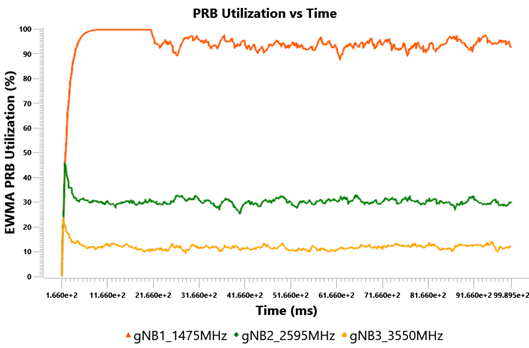
Initial PRB Utilization (without CIO)
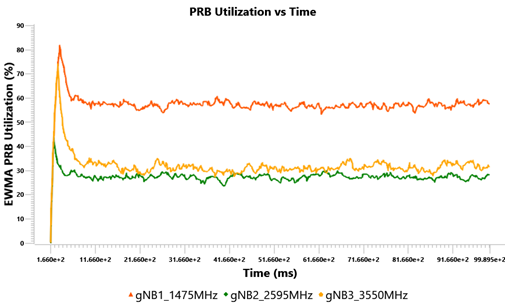
PRB Utilization After CIO
| gNB | Without CIO | With CIO |
|---|---|---|
| gNB1 | ~100% | ~70% |
| gNB2 | ~30% | ~35% |
| gNB3 | ~25% | ~40% |
Following CIO adjustments, PRB utilization at gNB1 decreased from near full allocation to approximately 70%. At gNB3, PRB utilization increased from 25% to around 40%.
Observations
The CIO adjustments changed the UE association. The load on the lowest-frequency gNB decreased, and resource utilization on the higher-frequency gNBs increased. The scheduling algorithm, radio configuration and physical network topology did not change.
Conclusion
We simulated scenarios in NetSim with frequency-specific CIO values, to redistribute UE associations and balance PRB allocation across gNBs. 3GPP specifications define the method, and Self-Organizing Network (SON) systems can apply it for automated parameter control.
The results showed that the 5G network load moved without hardware changes. Low-band congestion decreased from 100% to 70%, and high-band utilization increased from 25% to 40%.