NetSim NTN, Verified Against 3GPP TR 38.821
Set 1 · LEO-600 and LEO-1200 · S-band · Handheld UE
In Release 16, the companies in 3GPP RAN1 ran common calibration cases to align their NTN system-level simulators. We ran four of those cases in NetSim. The NetSim CDFs of coupling loss and Geometry SINR lie on the curves that 11 companies reported to 3GPP.
The six reference scenarios in TR 38.821
TR 38.821 defines six reference scenarios by orbit, payload type and beam behaviour (Table 4.2-1 of the report).
| Transparent satellite | Regenerative satellite | |
|---|---|---|
| GEO based non-terrestrial access network | Scenario A | Scenario B |
| LEO based non-terrestrial access network: steerable beams | Scenario C1 | Scenario D1 |
| LEO based non-terrestrial access network: the beams move with the satellite | Scenario C2 | Scenario D2 |
The calibration assumptions of Table 6.1.1.1-5 apply to scenarios A, C2 and D2. The four cases on this page are LEO cases. NetSim runs them with a transparent payload, which is Scenario C2.
What we compare against
The 3GPP Release 16 study on NR over non-terrestrial networks, and the calibration data behind it.
The study
3GPP studied NR over non-terrestrial networks in Release 16. TR 38.821 reports the study.
The common cases
Table 6.1.1.1-9 of TR 38.821 lists 30 calibration study cases. The companies ran them with the assumptions of Table 6.1.1.1-5, to align their system-level simulators.
The data
R1-1913404 (Thales, RAN1#99) collects the downlink CDFs of each company. Table 6.1.1.2-1 of TR 38.821 reports the average of these results.
Companies with downlink results in R1-1913404
- Thales
- ESA
- Ericsson
- ZTE
- Panasonic
- Huawei
- MediaTek
- Nokia
- Nomor
- Samsung
- Sony
- NetSim (this comparison)
| Source | Title | Used here for |
|---|---|---|
| TR 38.821, Table 6.1.1.1-1 | Set-1 satellite parameters for system level simulator calibration | EIRP density, maximum gain and beamwidth per orbit |
| TR 38.821, Table 6.1.1.1-3 | UE characteristics for system level simulations | Handheld UE: 23 dBm, 0 dBi, 7 dB noise figure, 290 K |
| TR 38.821, Table 6.1.1.1-5 | System Level Simulation assumptions for calibration | Bandwidth, re-use options, channel, UE distribution, metrics |
| TR 38.821, Table 6.1.1.1-9 | List of calibration study cases | Definitions of cases 9, 10, 14 and 15 |
| TR 38.821, Table 6.1.1.2-1 | Calibration results on DL transmissions | Reference 5th, 50th and 95th percentiles |
| R1-1913404 | System Level Calibration Results for NTN on DL transmissions | The CDF curve of each company |
Four LEO cases: S-band, handheld UE, downlink
The cases cover two altitudes and two frequency re-use factors. All four use satellite parameter Set 1.
| Case | Satellite orbit | Central beam elevation | Terminal | Frequency band | Frequency re-use | Beams in NetSim |
|---|---|---|---|---|---|---|
| SC9 | LEO-600 | 90° | Handheld | S-band | Option 1: re-use factor 1 | 61 |
| SC10 | LEO-600 | 90° | Handheld | S-band | Option 2: re-use factor 3 | 127 |
| SC14 | LEO-1200 | 90° | Handheld | S-band | Option 1: re-use factor 1 | 61 |
| SC15 | LEO-1200 | 90° | Handheld | S-band | Option 2: re-use factor 3 | 127 |
Case definitions: TR 38.821 Table 6.1.1.1-9. Re-use options: Table 6.1.1.1-5. Each case has 19 metric beams with 10 UEs per beam, so each CDF contains 190 UEs.
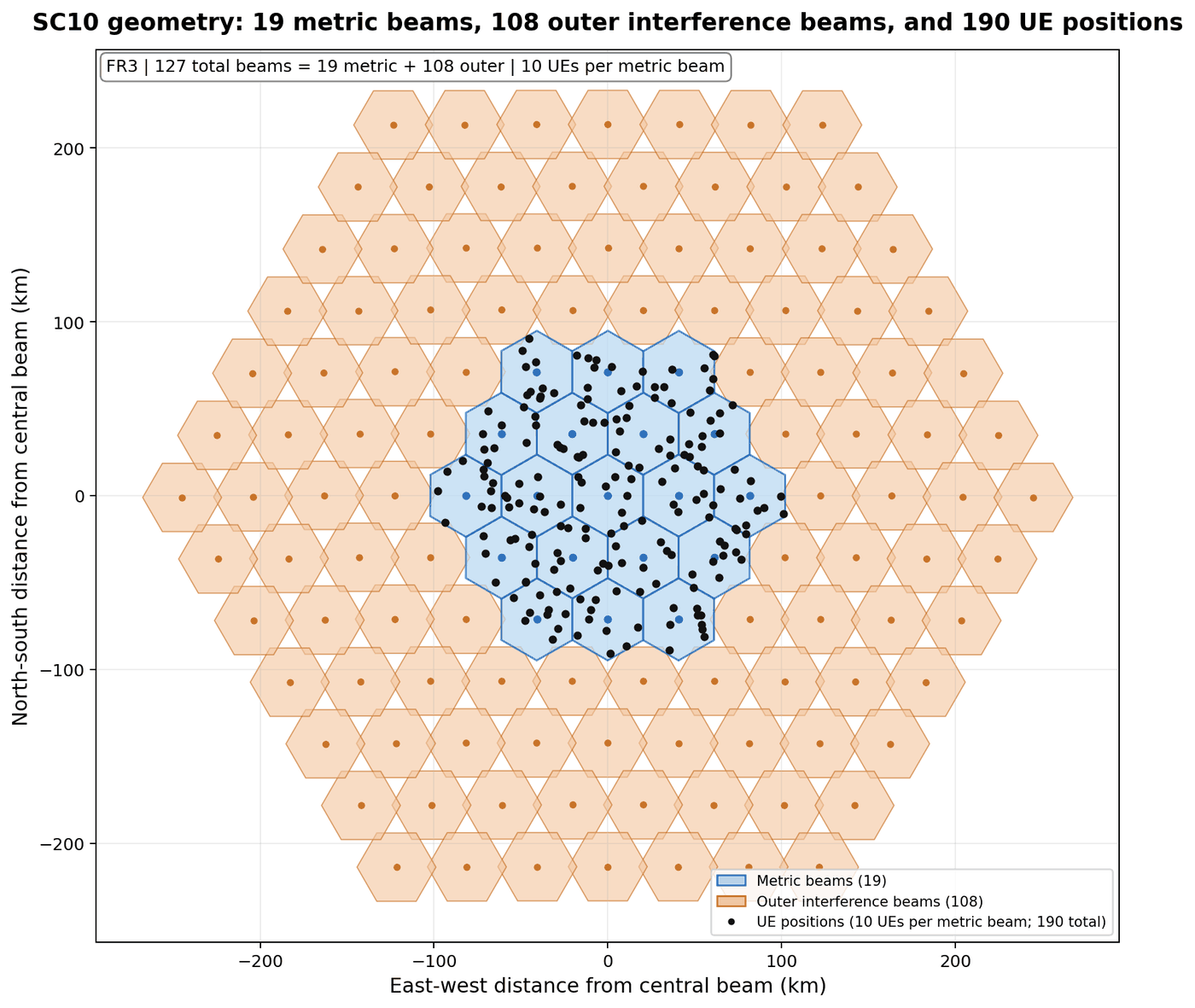
19 metric beams inside an outer interference field
TR 38.821 takes its statistics from the inner 19 beams and requires an independent simulation of the surrounding beams.
Figure 1: SC10 downlink geometry. Axes show distance from the central beam in km.
- Metric beams. The 19 blue cells. Only UEs in these cells enter the CDFs.
- Outer interference beams. The orange cells. They transmit on the same channel and supply the surrounding interference.
- UE positions. The black dots. NetSim places 10 UEs uniformly inside the Voronoi cell of each metric beam.
| Re-use factor | Additional tiers | Metric | Outer | Total |
|---|---|---|---|---|
| 1 (SC9, SC14) | 2 | 19 | 42 | 61 |
| 3 (SC10, SC15) | 4 | 19 | 108 | 127 |
The tier counts follow TR 38.821 Section 6.1.1.1: two additional tiers for FRF = 1, and four additional tiers for FRF > 1.
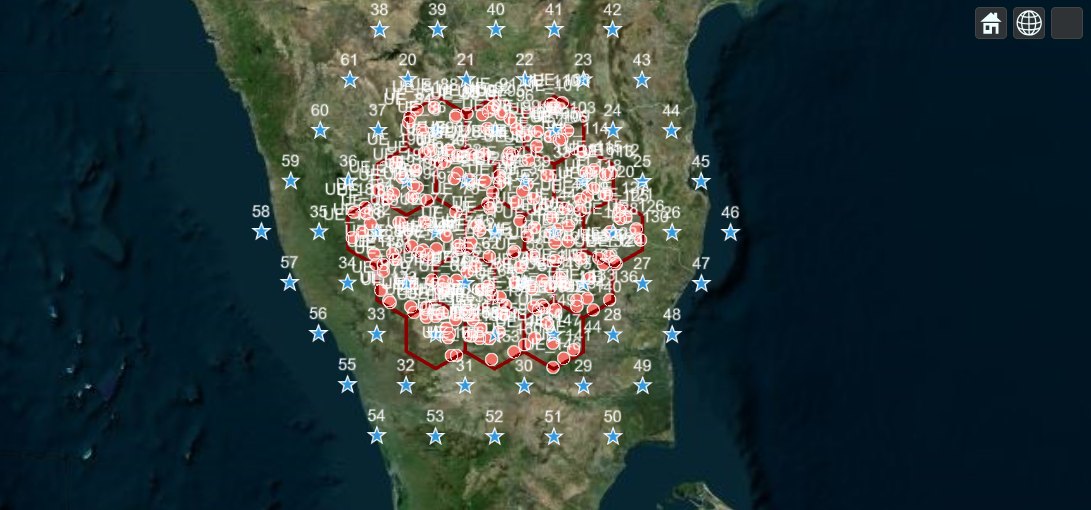
Figure 2: The same SC10 scenario in NetSim. Stars: beam centres. Red outline: metric beams. Red dots: UEs.
NetSim configuration
One configuration serves all four cases. Only the orbit and the re-use factor change.
| Parameter | NetSim setting | 3GPP reference |
|---|---|---|
| Satellite | One transparent LEO satellite per case. 600 km for SC9 and SC10, and 1200 km for SC14 and SC15. | Table 6.1.1.1-9 |
| Satellite EIRP density | 34 dBW/MHz for LEO-600 and 40 dBW/MHz for LEO-1200, applied per beam. | Table 6.1.1.1-1 |
| Satellite Tx max gain | 30 dBi | Table 6.1.1.1-1 |
| Satellite antenna pattern | Bessel function | TR 38.811 Section 6.4.1 |
| Carrier | S-band, NetSim band n256, 1985–2015 MHz | Table 6.1.1.1-5: S-band (i.e. 2 GHz) |
| Bandwidth | 30 MHz, 160 PRBs, 15 kHz subcarrier spacing (μ = 0) | Table 6.1.1.1-5: DL 30 MHz |
| Frequency re-use factor | 1 for SC9 and SC14, and 3 for SC10 and SC15 | Table 6.1.1.1-5, Options 1 and 2 |
| Central beam elevation | 90° | Table 6.1.1.1-6 |
| Channel | Rural, 100% outdoor UEs, clear sky, line of sight | Table 6.1.1.1-5 |
| Losses | Atmospheric absorption enabled. Scintillation, clutter and additional losses set to zero. | Table 6.1.1.1-5, NOTE 2 |
| Interference | Downlink, exact geometric model. All co-channel beams interfere. | Section 6.1.1.1 |
| UE attachment | RSRP | Table 6.1.1.1-5 |
| UE radio | Handheld, height 1.5 m, 23 dBm, antenna gain 0 dBi, noise figure 7 dB, antenna temperature 290 K | Table 6.1.1.1-3 |
| UE antenna branches | One transmit and one receive branch in the saved NetSim cases. The 3GPP handheld reference has two receive branches. | Table 6.1.1.1-3 |
| UE distribution | 10 UEs per metric beam, uniform in the Voronoi cell of each beam centre. 190 UEs in total. | Table 6.1.1.1-5 |
| Mobility and duration | Stationary UEs, 5 seconds | |
| Traffic | One UDP full-buffer application per UE, 1460-byte packets | |
| PHY and scheduler | QAM256 MCS table, zero BLER, round robin | |
| Logs | NTN Radio Measurement Log and NTN UE Beam Association Log |
Table 1: NetSim parameters for the Set-1 downlink calibration. Table numbers refer to TR 38.821.
The two metrics, and how NetSim computes them
Table 6.1.1.1-5 names the calibration metrics: coupling loss and geometry.
Coupling loss
The signal loss from the satellite antenna port to the UE antenna port. It depends on the distance, the channel model and the two antenna patterns, so it tests the geometry and the propagation model.
Geometry SINR
C, I and N are the carrier, interferer and noise power levels measured over the configured signal bandwidth (TR 38.821 Table 6.1.1.2-1, NOTE). It adds the interference model and the UE noise figure to the test.
- Run the case in NetSim
- Read the downlink records of the radio measurement log
- Take the time mean for each UE
- Form the CDF across the 190 UEs
The time mean gives every UE the same weight in the CDF, whatever its number of log records. The beam association log confirms the serving beam of each UE.
Results: NetSim on the 11 company curves
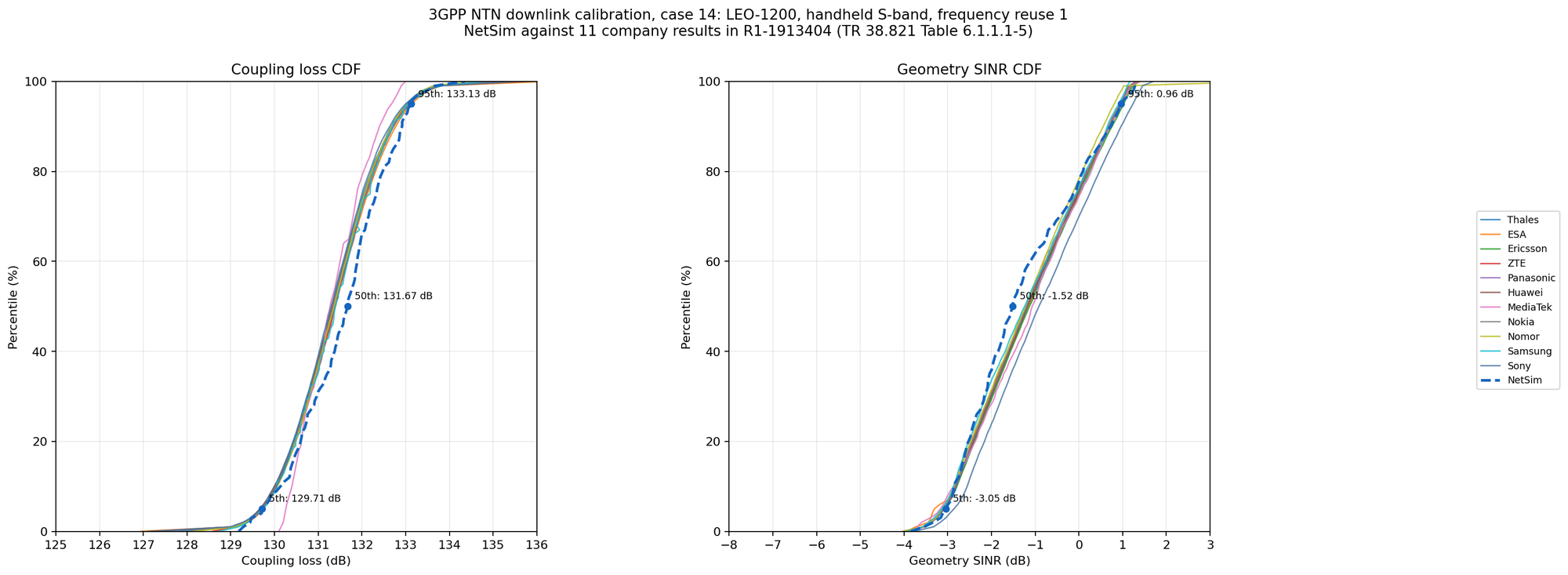
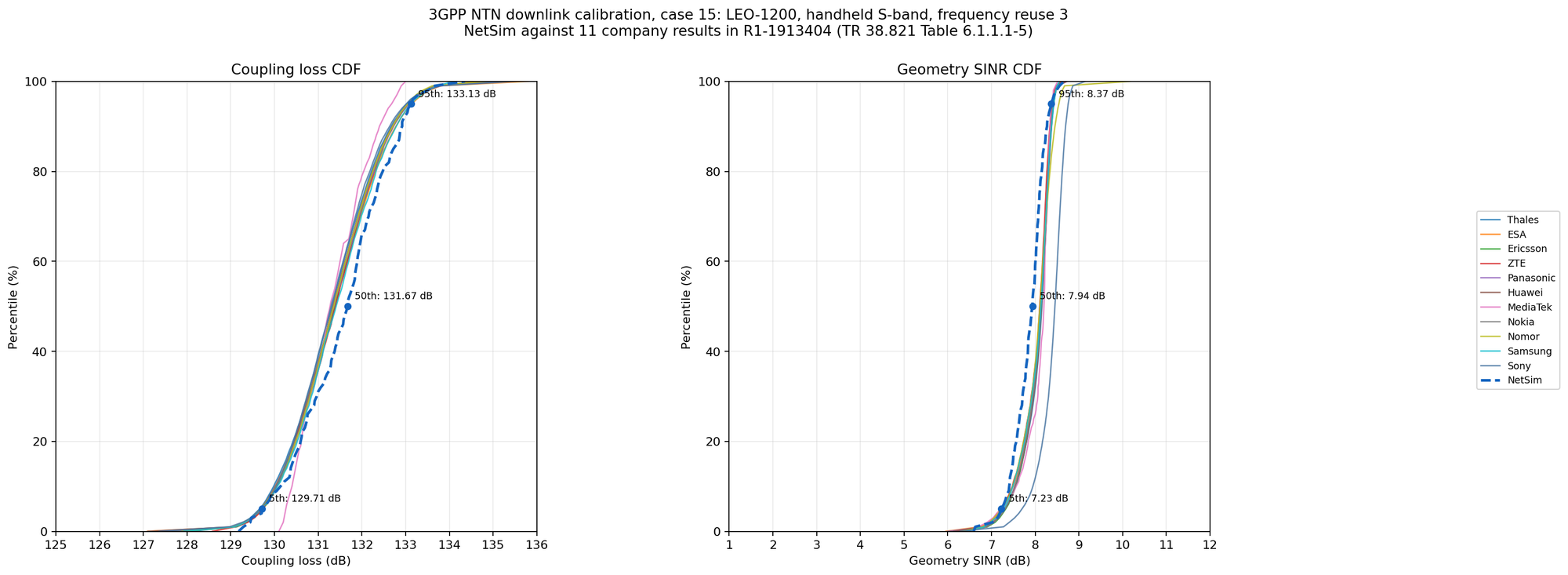
Solid lines: the company curves of R1-1913404. Dashed blue line: NetSim. The 3GPP columns are the values of TR 38.821 Table 6.1.1.2-1. All values are in dB.
LEO-600, re-use factor 1
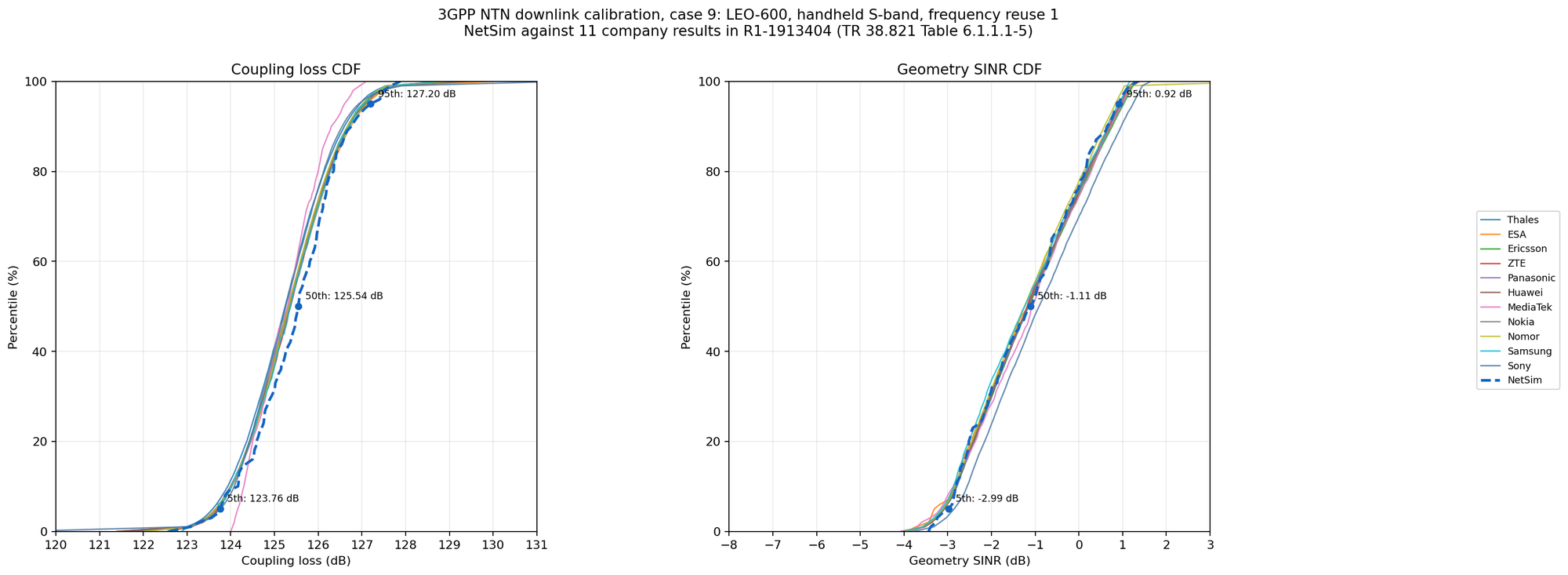
| Metric | 5th percentile | 50th percentile | 95th percentile | |||
|---|---|---|---|---|---|---|
| 3GPP | NetSim | 3GPP | NetSim | 3GPP | NetSim | |
| Coupling loss | 123.7 | 123.759 | 125.3 | 125.540 | 127.0 | 127.200 |
| Geometry SINR | −3.1 | −2.985 | −1.1 | −1.107 | 1.0 | 0.917 |
LEO-600, re-use factor 3
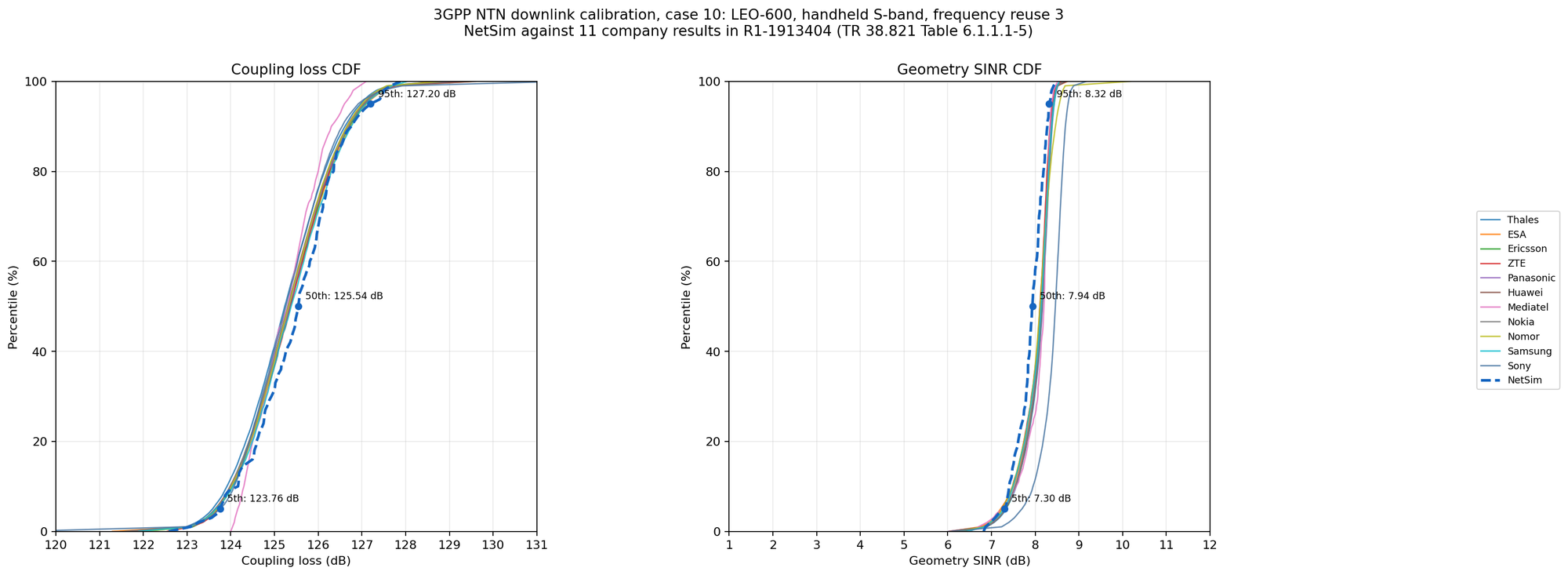
| Metric | 5th percentile | 50th percentile | 95th percentile | |||
|---|---|---|---|---|---|---|
| 3GPP | NetSim | 3GPP | NetSim | 3GPP | NetSim | |
| Coupling loss | 123.7 | 123.759 | 125.3 | 125.540 | 127.0 | 127.200 |
| Geometry SINR | 7.3 | 7.297 | 8.2 | 7.937 | 8.5 | 8.318 |
LEO-1200, re-use factor 1
| Metric | 5th percentile | 50th percentile | 95th percentile | |||
|---|---|---|---|---|---|---|
| 3GPP | NetSim | 3GPP | NetSim | 3GPP | NetSim | |
| Coupling loss | 129.8 | 129.715 | 131.3 | 131.670 | 133.0 | 133.126 |
| Geometry SINR | −3.1 | −3.048 | −1.1 | −1.516 | 1.0 | 0.958 |
LEO-1200, re-use factor 3
| Metric | 5th percentile | 50th percentile | 95th percentile | |||
|---|---|---|---|---|---|---|
| 3GPP | NetSim | 3GPP | NetSim | 3GPP | NetSim | |
| Coupling loss | 129.8 | 129.715 | 131.4 | 131.670 | 133.0 | 133.126 |
| Geometry SINR | 7.3 | 7.227 | 8.2 | 7.937 | 8.5 | 8.366 |
The percentiles agree
Across the four cases and the two metrics, the largest difference between a NetSim percentile and the TR 38.821 value is 0.42 dB. It occurs at the SC14 median Geometry SINR.
Altitude sets the coupling loss
The median coupling loss rises by 6.1 dB from LEO-600 to LEO-1200. Doubling the distance adds 6.0 dB of free-space loss. Set 1 raises the EIRP density by 6 dB at LEO-1200, so Geometry SINR stays nearly the same.
Re-use factor sets the SINR
With re-use factor 1, every beam interferes and the median Geometry SINR is near −1 dB. With re-use factor 3, fewer beams share the channel and the median rises to 7.9 dB.
Throughput and capacity for the same four cases
The same runs also report application throughput. These are NetSim results with full-buffer traffic. The throughput results in TR 38.821 Section 6.1.1.3 use FTP traffic at set resource utilisation, so the two sets do not compare.
| Case | Satellite capacity (Mbps) | Beam radius (km) | Area traffic capacity (kbps/km²) | Average spectral efficiency (bits/s/Hz/TRxP) |
|---|---|---|---|---|
| SC9 | 251.456 | 23.611 | 9.138 | 0.441 |
| SC10 | 330.489 | 23.611 | 12.010 | 0.580 |
| SC14 | 242.798 | 47.221 | 2.206 | 0.426 |
| SC15 | 330.418 | 47.221 | 3.002 | 0.580 |
Table 2: Capacity metrics over the 19 metric beams.
Satellite capacity
The sum of the application throughput of the 190 downlink applications, one per UE.
Area traffic capacity
Satellite capacity divided by the area of the 19 metric beams, where R is the beam radius:
Average spectral efficiency
Satellite capacity divided by the bandwidth of the 19 metric beams:
| Case | Throughput per UE (Mbps) | Throughput per beam (Mbps) | ||||
|---|---|---|---|---|---|---|
| 5th | 50th | 95th | 5th | 50th | 95th | |
| SC9 | 0.695 | 1.092 | 1.872 | 11.283 | 13.292 | 15.182 |
| SC10 | 1.600 | 1.755 | 1.761 | 16.971 | 17.409 | 17.748 |
| SC14 | 0.695 | 1.089 | 1.688 | 11.183 | 12.763 | 14.222 |
| SC15 | 1.657 | 1.755 | 1.761 | 17.235 | 17.392 | 17.555 |
Table 3: Percentiles of application throughput. The per-beam value is the sum over the 10 UEs of a metric beam.
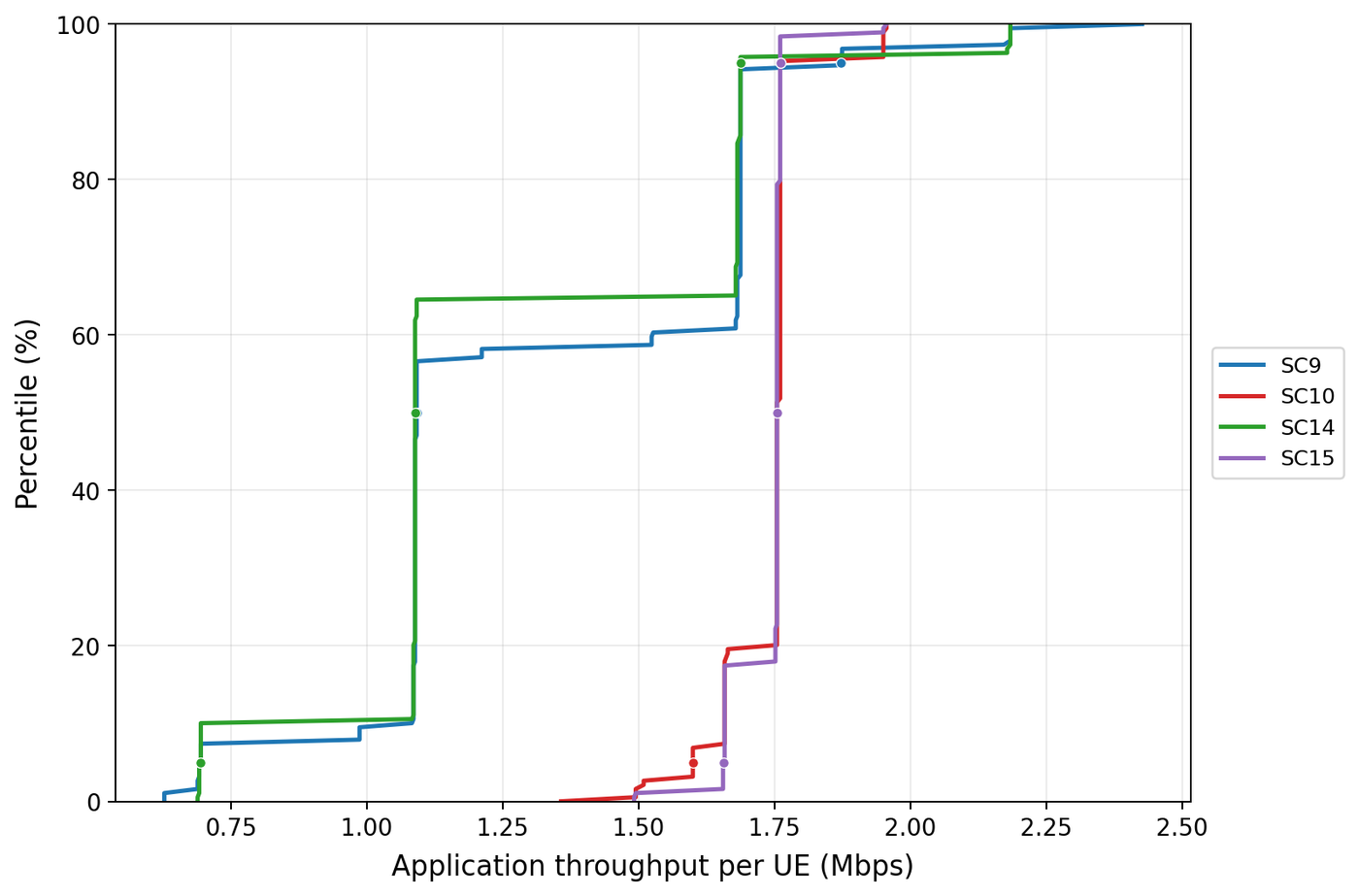
Figure 3: CDF of application throughput per UE.
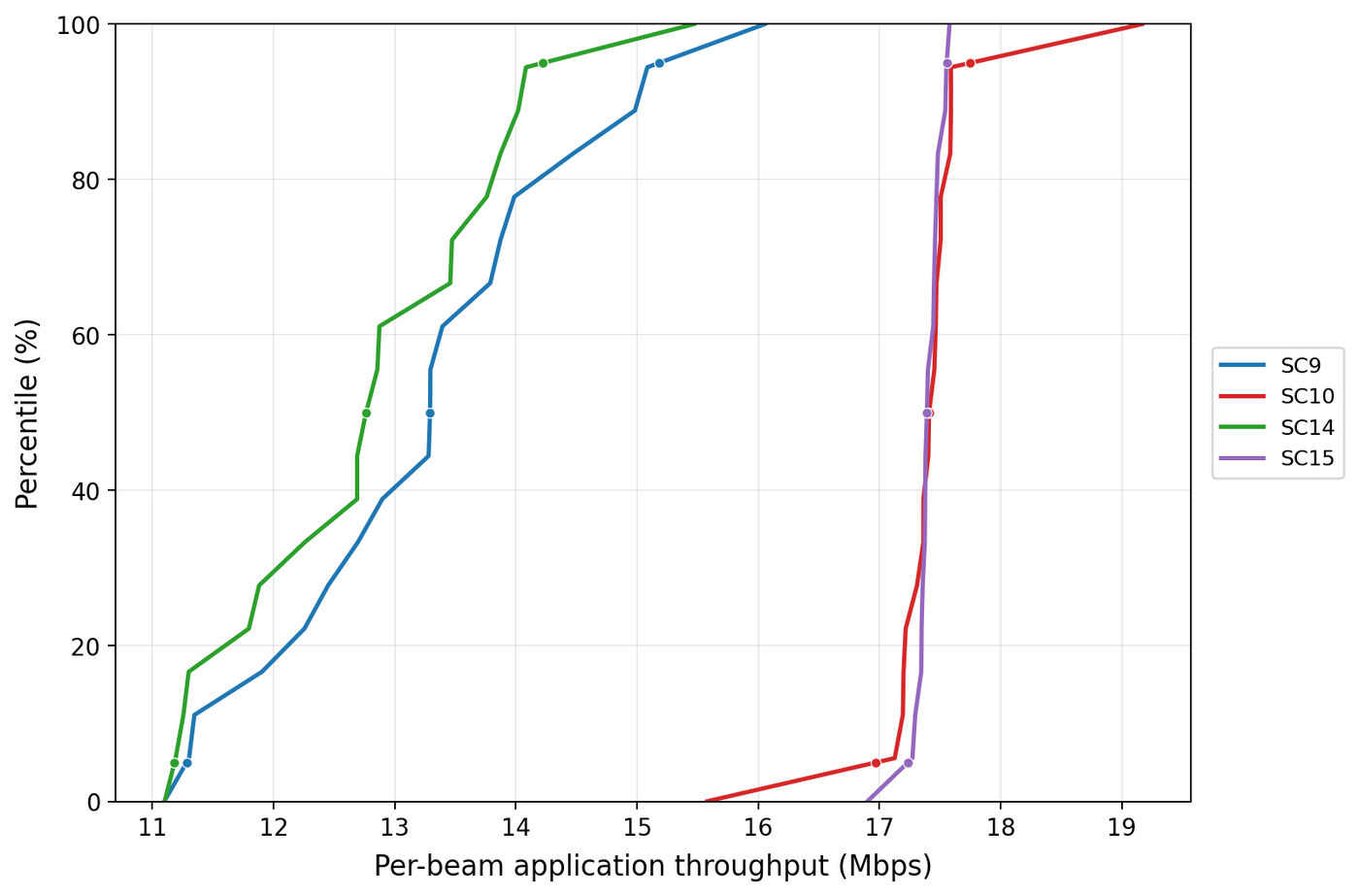
Figure 4: CDF of application throughput per beam.
Throughput follows Geometry SINR. The re-use factor 3 cases deliver about 330 Mbps at both altitudes, because their SINR distributions match. The re-use factor 1 cases deliver less, and their UEs spread over a wider throughput range.
Reproduce these results in NetSim
The example ships with NetSim, with its configuration files and results. The NetSim 5G NTN manual explains it step by step.
References: 3GPP TR 38.821 V16.2.0, “Solutions for NR to support non-terrestrial networks (NTN)”. R1-1913404, “System Level Calibration Results for NTN on DL transmissions”, Thales, RAN1#99.