Internet of Things & Wireless Sensor Networks
Sensors · Zigbee · 6LoWPAN · Mesh routing
NetSim models IoT as a wireless sensor network that connects to the wider internet through a 6LoWPAN gateway. Build large sensor deployments with the quick-placement utility, then simulate the full stack: IEEE 802.15.4 PHY and MAC, multi-hop routing and per-node energy use. NetSim provides the protocol source code in C.
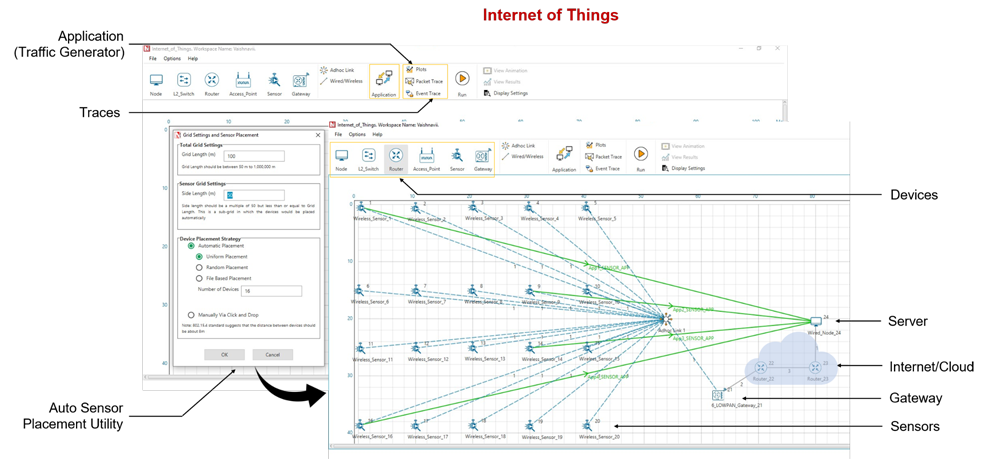
What NetSim models
NetSim models how sensor data moves across the network, not the data itself. Sensors are abstract: each one represents any sensing or embedded device and sends measurement packets.
Abstract sensors
A single sensor model represents any sensor or embedded device that senses physical properties or random fields, such as temperature or pressure.
Data as IP packets
The sensors send data as IP packets, with a size and inter-arrival time that you set. You therefore control the offered load precisely.
6LoWPAN gateway
The WSN connects to an internetwork through a 6LoWPAN gateway with two interfaces. A Zigbee (802.15.4) radio faces the sensors, and a WAN interface faces the internet.
Network-focused
NetSim simulates packet transport over the IoT network. It does not process the application payload or perform data storage and analytics on it.
The NetSim IoT / WSN stack
Each device runs a full protocol stack, so experiments show real protocol behaviour from the application down to the radio.
Sensor and standard traffic
A sensor application generates measurement packets. Standard NetSim applications such as Voice, Video and CBR can run at the same time.
UDP
The transport layer carries the short, delay-tolerant messages typical of sensor reporting.
Multi-hop routing
The AODV and RPL ad hoc routing protocols build multi-hop paths from sensors to the sink. Static IP routing is also supported.
IEEE 802.15.4 (Zigbee)
The MAC and PHY follow IEEE 802.15.4, with CSMA/CA access in both beacon-enabled and non-beacon modes.
Energy model
NetSim tracks power use in the transmit, receive and idle states, and supports energy harvesting. You can then estimate battery drain and network lifetime.
Protocol source in C
Each layer ships with C source code. Modify the stack in Visual Studio to build custom protocols or new application models.
IEEE 802.15.4 at a glance
The standard defines a low-data-rate, low-power, short-range radio. NetSim models its PHY and MAC behaviour with configurable parameters.
PHY layer
The 2.4 GHz ISM band carries 16 channels of 2 MHz each. OQPSK with direct-sequence spread spectrum yields a raw bit rate of 250 kbps.
CSMA/CA access
Nodes contend with a random back-off, a clear channel assessment, and optional acknowledgements and retries. Access is slotted in beacon mode and unslotted in non-beacon mode.
Beacon and superframe
In beacon-enabled mode, a superframe (beacon, contention access period and contention free period) gives synchronised, low-duty-cycle operation. Non-beacon mode gives simpler always-on access.
Configurable defaults
Symbol time 16 µs, slot time 320 µs, macMinBE 3, macMaxBE 5, macMaxCSMABackoffs 4 and max frame retries 3. You can set the transmit power, receiver sensitivity and ED threshold.
From sensor to server
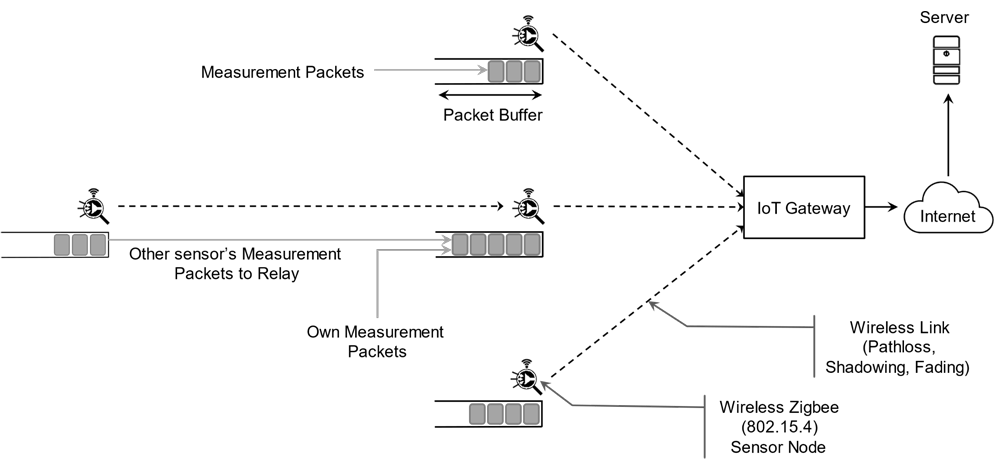
Sensors generate measurement packets that queue in a packet buffer, then travel directly or over multiple hops across a wireless link to the gateway. The gateway forwards them over the internet to a server.
Wireless links support a range of propagation models, and ad hoc routing finds multi-hop paths. The MAC and PHY layer protocol is IEEE 802.15.4.
What you can study
Worked experiments from the IoT and WSN manual, ready to load, run, and extend.
One-hop 802.15.4 throughput
Send back-to-back packets from a single sensor and compare the simulated saturation throughput (about 104.7 kbps) against the analytical CSMA/CA timing budget (about 105.4 kbps).
Multi-hop sensor-sink path
Watch the packet delivery rate fall as the sensor-sink distance increases, with a log-distance path-loss model. Find the distance at which you need an intermediate router.
Star-topology network
Evaluate the performance of a star topology in which several sensors report to a single PAN coordinator.
Superframe order vs throughput
Vary the 802.15.4 superframe order in beacon-enabled mode and observe its effect on throughput.
Performance metrics and log files
The results appear in a dashboard and plot window as soon as a run completes. The trace and log files give more detail.
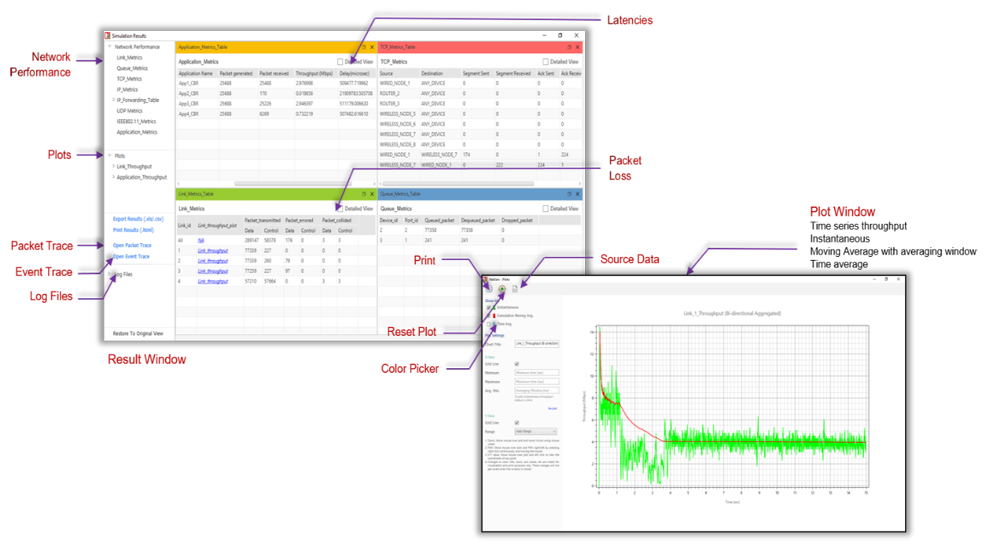
The result dashboard and plot window shown in NetSim after a simulation completes.
Performance measures
- End-to-end delay and jitter
- Errors and collisions
- Packets generated, received, collided
- Route tables
- TCP acks and retransmissions
Multi-level results
- Per interface
- Per device
- Per application
- Per link
- Network-wide summary
Trace and logs
- Per-packet trace files
- Protocol log files
- IEEE 802.15.4 radio measurements: path loss, shadow fading, Rx power, SNR, SINR, BER
Export and integration
- CSV export for Excel
- pcap capture for Wireshark
- MATLAB and Python interfacing, offline or at run time
White paper
A worked study that validates NetSim against analysis for beaconless 802.15.4 sensor networks.
Performance analysis of 802.15.4-based WSNs
- Analysis of WSNs that rely on beaconless IEEE 802.15.4
- Five cases covering single-hop and multi-hop sensor-to-base-station scenarios
- Radio propagation calculations for transmission range and carrier sense range
- Throughput versus source rate across sensors and configurations
Publications that used NetSim
These peer-reviewed IoT and wireless sensor network papers used NetSim to build and validate their models.
Watch it in action
A webinar on IoT R&D with NetSim, machine-learning integration, and hardware interfacing.
 ▶
▶
IoT R&D with NetSim (Webinar, Part 1)
 ▶
▶
IoT R&D with NetSim (Webinar, Part 2)
 ▶
▶
Machine Learning with IoT: ML Classifiers and Attack Detection
 ▶
4:28
▶
4:28
Interfacing Raspberry Pi with NetSim
On the roadmap
The development team is extending the library from short-range Zigbee to long-range, low-power wide-area networks.
LoRaWAN support
A LoRaWAN model pairs the long-range LoRa PHY with the LoRaWAN MAC. It covers sub-GHz ISM operation, and the star-of-stars topology in which end devices reach a network server through gateways.
Spreading factors and data rates
Chirp spread spectrum with selectable spreading factors, which trade data rate against range and link budget. The model also includes adaptive data rate behaviour.
Device classes and scale
Class A, B and C end-device behaviour, with large-scale deployments of low-power devices that report to a small number of gateways.