Introduction
NetSim satellite library models end-to-end, full stack, packet level communication between terrestrial nodes and Geostationary satellites. Geo satellites have the unique property of remaining permanently fixed in exactly the same position in the sky as viewed from any fixed location on Earth. This means ground-based antennas do not need to track them but can remain fixed in one direction. These satellites have orbital period that is the same as Earth’s rotation period and are the most common type of communications satellites.
The Satellite MAC layer protocol supported in NetSim is TDMA for forward link and MF-TDMA for return link (based on the DVB S2 standards). The forward link is in the Ku band (12 – 18 GHz) while the return link is in the Ka band (26 – 40 GHz)
The satellite can be thought of as a relay station. It operates on the bent-pipe (transparent star) principle, sending back to Earth what comes in, with only amplification and a shift from uplink to downlink frequency.
In NetSim, the satellite communication network library interfaces with Internetworks library. This means users can connect Satellite gateway and User Terminals to devices such as Routers, Switches Wired nodes, Access point and Wireless nodes etc.
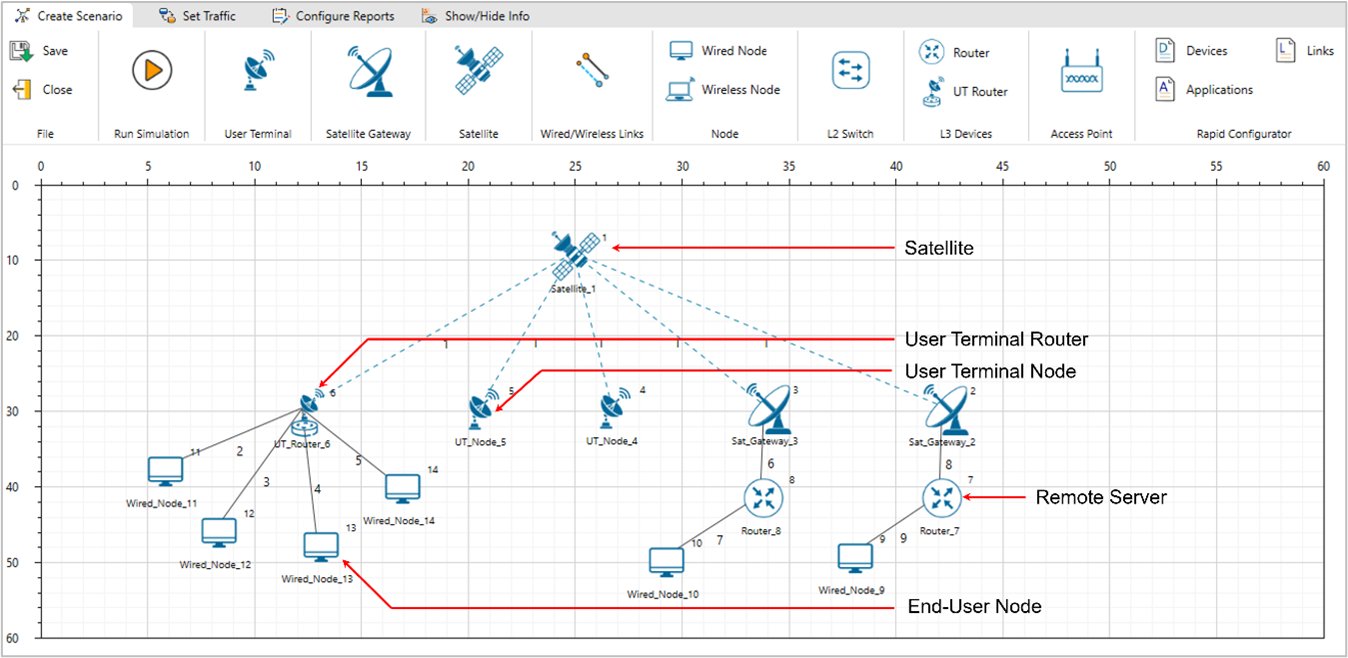
Figure-1: NetSim GUI showing Satellite User Terminals connected to a server via satellite links.
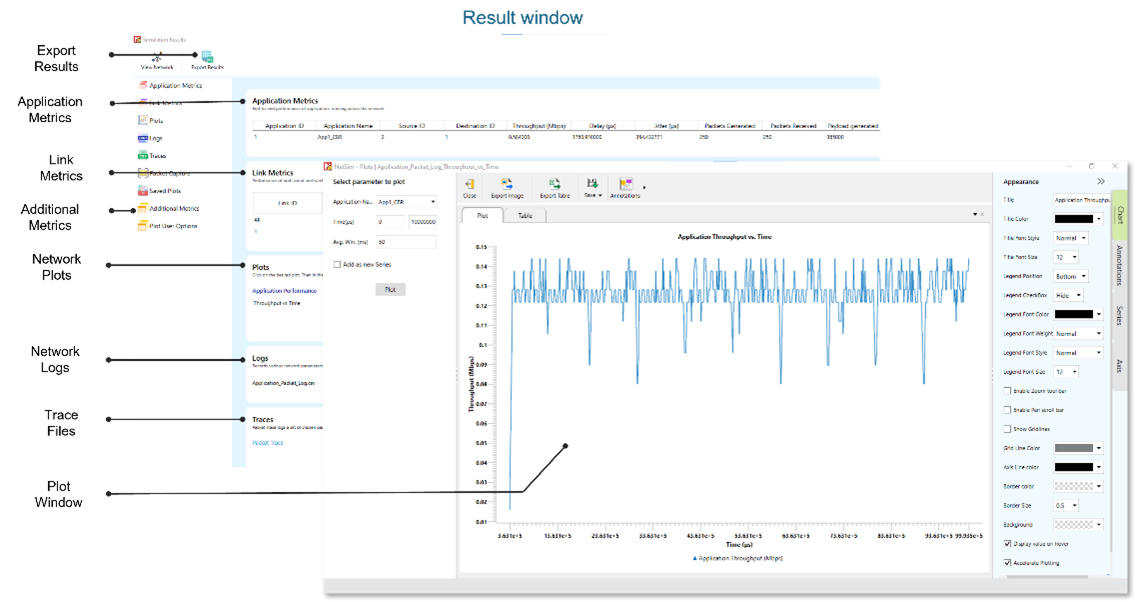
Figure-2: The Result dashboard and Plot window shown in NetSim after completion of simulation
The PHY layer models include:
Channel model: Friis free space path loss with Markov Loo fading model.
Modulation: QPSK, 8PSK, 16APSK, 16QAM, 32APSK with appropriate coding rates.
Rx Antenna gains.
Antenna gain to noise temperature.
All the choices of transport protocols, and all types of applications in unicast mode can be run.
NetSim’s protocol source C code shipped along with (standard / pro versions) is modular and customizable to help researchers to design and test their own sat-com protocols.