 |
NetSim Source Code Help
|
|
NetSim Source Code Help
|

Go to the source code of this file.
Macros | |
| #define | PD 0.9 |
Functions | |
| int | fn_NetSim_CR_FormChannelSet (BS_PHY *pstruBSPhy) |
| int | fn_NetSim_CR_AssociateCPE (NETSIM_ID nDeviceId, NETSIM_ID nInterfaceId) |
| int | fn_NetSim_CR_SSA_Initialization (BS_MAC *pstruBSMAC, BS_PHY *pstruBSPHY) |
| int | fn_Netsim_CR_SM_ScheduleQuietPeriod (BS_PHY *pstruBSPhy, SCH *pstruSCH) |
| int | fn_NetSim_CR_QuietPeriod () |
| struct stru_802_22_SSFOutput * | fn_NetSim_CR_CPE_SSF (struct stru_802_22_SSFInput *input, NETSIM_ID nDevId, NETSIM_ID nInterfaceId) |
| int | fn_NetSim_CR_BS_UCS () |
| int | fn_NetSim_CR_CPE_SwitchChannel () |
| int | fn_NetSim_CR_UpdateChannel () |
| #define PD 0.9 |
The Spectrum Sensing Function observes the RF spectrum of a television channel for a set of signal types and reports the results of this observation. The spectrum sensing function is implemented in both the base station and the CPEs. There are MAC management frames that allow the base station to control the operation of the spectrum sensing function within each of the CPEs. The inputs to the spectrum sensing function come from the SM via SSA. The use of any specific sensing technique is optional, as long as the inputs, outputs and behavior meet the specification of this sub clause.
Note: For further details, please Refer IEEE 802.22-2011 Document Section 10.4.1
Definition at line 277 of file SpectrumManager.c.
This function is used to perform CPE network entry & initialization process
Definition at line 44 of file SpectrumManager.c.

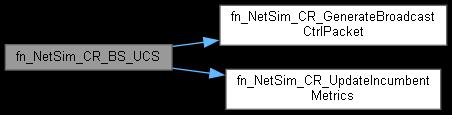
| int fn_NetSim_CR_BS_UCS | ( | ) |
Urgent Coexistence Situation Used by the CPE to alert the BS about an UCS with incumbents in the channel currently being used by the BS or either of its adjacent channels:
0: no incumbent (default)
1: incumbent detected
Definition at line 326 of file SpectrumManager.c.

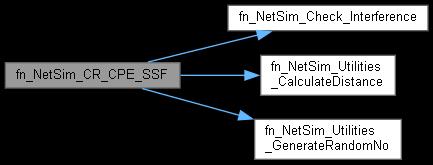
| struct stru_802_22_SSFOutput * fn_NetSim_CR_CPE_SSF | ( | struct stru_802_22_SSFInput * | input, |
| NETSIM_ID | nDevId, | ||
| NETSIM_ID | nInterfaceId | ||
| ) |
Definition at line 278 of file SpectrumManager.c.

| int fn_NetSim_CR_CPE_SwitchChannel | ( | ) |
When the BS decides to switch channels during normal operation, it shall execute the following procedure to determine when to schedule the channel switching operation. The BS selects the first backup channel from its backup/candidate channel list, it shall select a waiting time T46 to make sure that all its CPEs are prepared for the channel switch. The value of T46 is a configuration parameter that could be set by the management interface. The first requirement is the value of T46 shall be smaller or equal to the maximum allowed channel moving time and the second requirement is that is long enough for the CPEs to recover from an incumbent detection.
Note: For further details, please Refer IEEE 802.22-2011 Document Section 7.22.2
Definition at line 389 of file SpectrumManager.c.

| int fn_NetSim_CR_FormChannelSet | ( | BS_PHY * | pstruBSPhy | ) |
This function is used set the channel number and assign the channel characteristics for all channels
Definition at line 5 of file SpectrumManager.c.
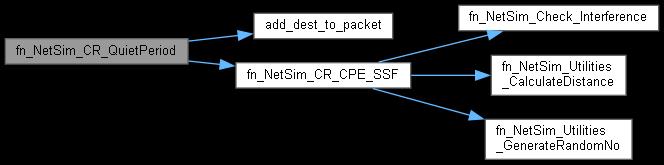
| int fn_NetSim_CR_QuietPeriod | ( | ) |
In order to meet the Channel Detection Time for detecting the presence of incumbents in the operating channel, an IEEE 802.22 network shall schedule network-wide quiet periods for sensing. During these quiet periods, all network traffic is suspended and base stations and CPEs shall perform in-band sensing. This process is coordinated by the BS, which is responsible for scheduling the quiet periods.
Note: For further details, please Refer IEEE 802.22-2011 Document Section 7.21
Definition at line 204 of file SpectrumManager.c.

The mechanism for quiet period management consists of the following two sensing stages, which are realized through the use of network-wide quiet periods, but which have different time scales: a) Intra-frame sensing b) Inter-frame sensing
For more Information,refer IEEE 802.22-2011 Document Section 7.21.1
Definition at line 168 of file SpectrumManager.c.

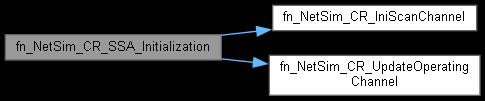
SSA initialization processes shall exist at the BS and CPE. In the case of the BS SSA initialization, if there is at least one available channel (N0), a selection shall be made and a second round of spectrum sensing shall then take place on the adjacent channels of the selected channel. If a WRAN signal is detected, RF signal sensing and signal classification shall then be carried out on the channel (N0+1 or N0–1 or both) through the sensing path during the identified quiet periods to verify the presence and the identity of the incumbent service underneath the WRAN operation. In such case, a new available channel will need to be selected.
Definition at line 153 of file SpectrumManager.c.
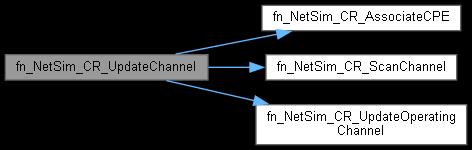
| int fn_NetSim_CR_UpdateChannel | ( | ) |
This function is used to update the operating channel as well as to update the event details
Definition at line 401 of file SpectrumManager.c.

 1.9.5
1.9.5